
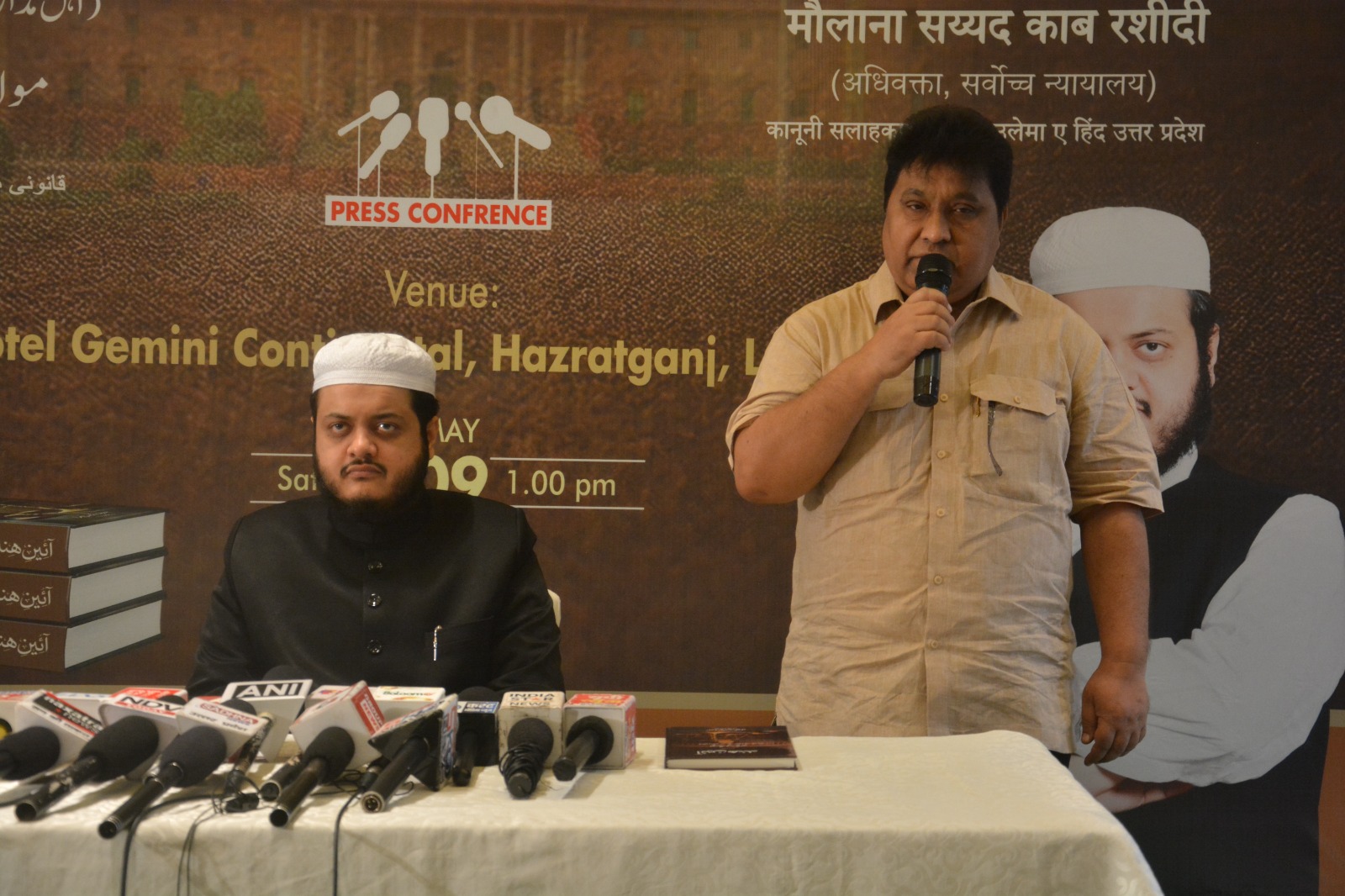
Lucknow. Madrasas have historically been an important pillar of India’s education system. Their goal has always been to develop their students into true Muslims as well as genuine citizens. In light of the current push for modern education in madrasas, a book has been developed to educate students about India’s laws and Constitution.
Written by Maulana Kab Rashidi, Legal Advisor to Jamiat Ulama-e-Hind, Uttar Pradesh, this book encompasses basic information about the Indian Constitution and various laws. It will undoubtedly provide students studying in madrasas with information about their legal and constitutional rights and duties, helping them become better citizens.
History bears witness to the significant contribution of madrasas in the social sphere, from India’s independence to the present. Madrasas have been central to the freedom movement, and numerous examples of this are recorded in the pages of history. However, over time, the need has been felt to ensure that children in these institutions are also educated about the law and the Constitution. Any society or organization can progress only by keeping pace with the times, and this applies to madrasas as well.
There are almost no examples of the Indian Constitution and law being taught as a subject in the curriculum implemented in madrasas across the country. Therefore, in the current situation, it is crucial that madrasa students be taught about the country’s law and constitution to develop them into better and more informed citizens. This book has been prepared to fulfill this purpose. In accordance with the new education policy in the modern era, and in accordance with the needs of children in the current circumstances, we are striving to include the Constitution as a part of our curriculum.
Maulana Rashidi stated that a comprehensive campaign will be launched to ensure that this book is included in the curriculum of all madrasas in the country. A comprehensive campaign will be launched to contact all madrasas and other religious education institutions across the country. Furthermore, mosques will be visited to motivate those responsible for this. Furthermore, various Madrasa Education Councils across the country will be contacted to ensure that this book is included in the curriculum of the madrasas under their supervision.
This book is, in fact, a beginning of reforms in madrasas. Given the current situation, it is repeatedly stated that reforms in madrasas are essential. But the most pressing question is: who will carry out these reforms? Will governments, or outsiders? Or will those who have spent their entire lives—fifty to sixty years—in madrasas? It can be clearly stated that only those who have been associated with madrasas from the beginning can bring about genuine and balanced reforms. Only those people truly understand the madrasa education system, its infrastructure, and its fundamental spirit. Therefore, it is essential that reforms are implemented in a way that does not harm the spirit of madrasas, but rather protects and strengthens them.
If the purpose for which the founders of madrasas founded these institutions is ignored in the name of reform, such reforms will not bode well for future generations. True reform is one that progresses with the times while preserving tradition and original objectives.
Maulana Rashidi stated that in the current circumstances, “constitutional consciousness” has become not just an academic necessity but also an essential duty for those associated with madrasas. This thought inspired the creation of this book. It attempts to present the basic spirit of the Indian Constitution in a simple yet meaningful manner, so that through this medium of knowledge and awareness, a path can be paved that is not only constitutional but also a mirror of dignity and balance.
The book, titled …., has a total of seven chapters and has been prepared psychologically to enable madrasa students to better understand the content and implement it in their lives. The first chapter of the book provides a brief overview of the background and struggle of the Indian independence movement. It provides a brief but meaningful account of the services and incomparable sacrifices of the freedom fighters.
The second chapter of the book offers a comprehensive and thought-provoking overview of the development of the judicial and constitutional system in India, describing the historical stages from ancient traditions to the modern era in a coherent sequence. It particularly sheds light on the background of the Constitution of India, through which this magnificent document reached its present form. In this context, the establishment of the Constituent Assembly, its composition, and its intellectual and practical role are clearly presented. Furthermore, the responsibilities of the Assembly’s various committees and sub-committees and the important personalities associated with them are carefully described.
The third chapter of the book focuses on the philosophy of the Indian Constitution and its Preamble, interpretation, and analysis. It elaborates on the main features and distinctive qualities of the Indian Constitution. This chapter also offers a detailed and precise discussion of the Preamble (rightly considered the “soul” of the Constitution). The fourth chapter presents a clear and simple outline of the position and authority of the Supreme Court. The fifth chapter introduces fundamental rights, their importance, and their constitutional status. Furthermore, the sixth chapter explains the historical background and nature of fundamental duties, demonstrating that these duties are not merely formal requirements; rather, they are an integral part of the governance of national life.
The final chapter of the book is a concise and comprehensive document on the constitutional status of Islamic educational institutions and the courts’ interpretations. It carefully compiles these important decisions of the Supreme Court and state courts.
This book is an attempt to develop students studying in madrasas into good citizens by providing them with basic knowledge of the Constitution and law, consistent with modern education. This is the need of the hour. It is hoped that not only madrasas but also governments that appear to favor mainstream education for their students will recognize its importance and support it.